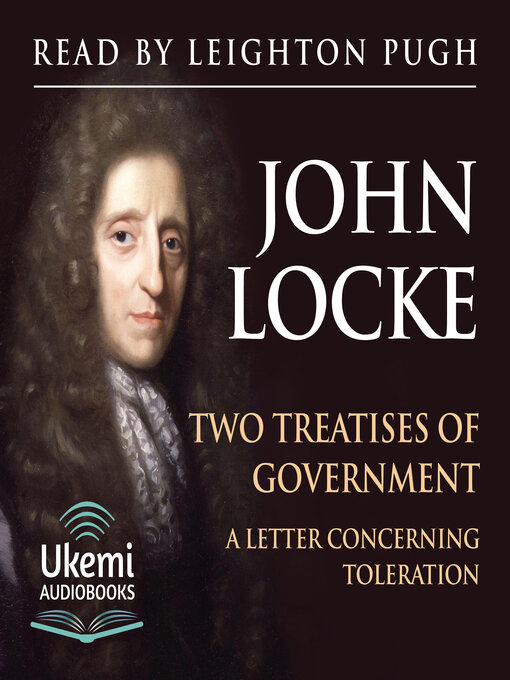
Two Treatises of Government and a Letter Concerning Toleration
AudiobookThe son of a Puritan family - his father fought as a captain of cavalry in the parliamentary army in the English Civil War - Locke was educated at Westminster school and then Oxford University, where he studied medicine and natural philosophy. He became the personal physician to the Earl of Shaftesbury, later the Lord Chancellor and founder of the Whig party.
It was probably at Shaftesbury's behest that he produced the Two Treatises Concerning Government. He began work on these in 1679, after travelling extensively in France. But in 1683 he fled to Holland following the failed Rye House Plot, in which he was suspected of having been involved by the authorities.
The Two Treatises would not be published until 1689, after the Glorious Revolution. The first treatise is essentially an in-depth critique of Robert Filmer's Patriarcha, a work which argued in favour of the divine right of kings and which was much referred to in the reign of Charles II, mainly by clerics preaching from the pulpit asserting the divine right in support of the monarch.
Locke systematically dismantles and invalidates every one of Filmer's assertions, dissecting his arguments one by one, invoking scriptural references in support of his counterarguments and disentangling and clarifying a host of ideas pertaining to the nature and origins of authority.
In the second treatise, which is the better known, much more influential and important work, Locke suggests a different account for the origins and nature of government, referring back to the Hobbesian notion of the state of nature postulating three basic natural rights: the right to life, to liberty and to property.
Section by section the philosopher examines his subject, lays out his thinking process and explains his conclusions, very different from Hobbes' ideas, articulating a series of beliefs and concepts now germane to government by liberal democracy: the separation of church and state, and of the legislative and executive powers, the doctrine of checks and balances and the labour theory of value being among them.
Locke's contention that populations had the justifiable right to overthrow tyrannical governments clearly influenced Thomas Jefferson and played an important part in the American Revolution and the setting up of the Republic. A Letter Concerning Toleration, here translated by William Popple, was originally written in Latin and focuses on the problems of religion and government advocating a philosophy of tolerance among Christians as the solution, albeit with certain qualifications. These seminal Locke works are read with brio by Leighton Pugh.
-
Creators
-
Publisher
-
Release date
December 1, 2019 -
Formats
-
OverDrive Listen audiobook
- ISBN: 9781004165384
- File size: 318196 KB
- Duration: 11:02:54
-
-
subjects
-
Languages
- English
Formats
- OverDrive Listen audiobook
subjects
Languages
- English
Why is availability limited?
×Availability can change throughout the month based on the library's budget. You can still place a hold on the title, and your hold will be automatically filled as soon as the title is available again.
The Kindle Book format for this title is not supported on:
×Read-along ebook
×The OverDrive Read format of this ebook has professional narration that plays while you read in your browser. Learn more here.